Monday, January 11, 2010

Japanese Highways, Bridges & Interchanges

Astounding Japanese Highways, Bridges & Interchanges

Japan saw most of its infrastructure bombed back to the stone age in the final years of World War II, which makes the country's post-war rejuvenation all the more astounding. Huge, complex public works projects saw a concrete & steel web of highways, bridges and interchanges blossom from the wreckage of war.
Today, shaped by the demands of restrictive space and economic boom & bust, Japan's hardened transportation arteries display artistic forms that go far beyond their functions.

Astounding Japanese Highways, Bridges & Interchanges

Japanese Highways, Bridges & Interchanges
(images credit: Ken Ohyama)
Above left is the Hakozaki Junction, part of the Metropolitan Expressway in Tokyo, and at right is the Hokko Junction in Osaka... These images illustrate the solution engineers used when building multi-lane highway interchanges in some of the world's most crowded cities in Japan: go vertical!
Japanese Highways, Bridges & Interchanges
(images credit: Ken Ohyama)
Ken Ohyama has made it his mission to chronicle some of the more striking Japanese roadworks in a Flickr series called Interchange and a book of his photos available from Amazon. One of the more outstanding examples is The Hokko Junction shown above - a part of the Hanshin Expressway near Japan's second city, Osaka.
Japanese Highways, Bridges & Interchanges
Also in Osaka is the Higashiosaka (East Osaka) Loop of the Hanshin Expressway. The photographer's technique gives the sweeping curve of the roadway an almost tubular appearance:
Japanese Highways, Bridges & Interchanges
(images credit: Ken Ohyama)
When engineers have space to work with, they take full advantage. This wide field view of the Higashiosaka interchange shows the almost organic complexity of a busy cloverleaf, resembling a living creature's circulatory system with the vehicles acting as blood cells.
Japanese Highways, Bridges & Interchanges
(image credit: zvkk)
Highways upon highways... without any end in sight:
Japanese Highways, Bridges & Interchanges
(images credit: Andrew Yamaguchi, Sergei Mingazhev, Stassia)
One interesting feature of Japanese elevated highways: they often run above rivers or sea channels, using the available space above the water. Here are some of these "highways on the sea" -
Japanese Highways, Bridges & Interchanges

(images credit: takasuuuui, kokix)
The incredible Japanese road infrastructure really took off in the 1960s - check out the vintage photo on the right:
Japanese Highways, Bridges & Interchanges
(left image credit: FotoOleg)
Such "Bladerunner" sights are commonplace now, brimming with urban energy -
Japanese Highways, Bridges & Interchanges
(images credit: kokix)
By the way, for the tricky "urban density" photography, head over to this page... and see if you can spot something wrong with the image there.
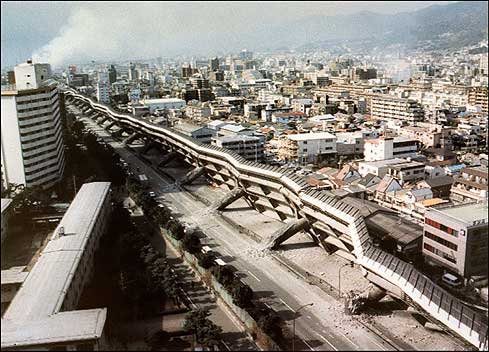
Slipping Sideways
Some sections of the Hanshin Expressway suffered severe damage during the 7.2 magnitude Great Hanshin Earthquake which hit the Kobe, Japan area in January of 1995, killing over 5,500 people and costing over $200 billion.
Japanese Highways, Bridges & Interchanges
(image credit: AFP / Jiji Press)
On the bright side, the affected sections of the highway did not "pancake", as happened in the 1989 Loma Prieta quake, but instead slipped sideways and tumbled over. Either way, one doesn't want to be driving through a highway interchange or junction when a big quake hits!
Recession, what recession?
Public works spending has long been the Japanese government's preferred way to spend budget surpluses, boost employment, keep the ruling party's supporters in the construction industry loyal, or all of the above. The highway depicted below is one of those projects, steadily overtaking a quiet city street like Godzilla in slow motion.
Japanese Highways, Bridges & Interchanges
(images credit: Cisco's Japan Blog and Snegura)
Which came first, the highway or the building? The question is moot as both have learned to accommodate one another. The Hanshin Expressway takes a shortcut through the 5th to 7th floors of Fukushima's Gate Tower building, also known as the Bee Hive.
Japanese Highways, Bridges & Interchanges
(images via)
The story goes that the original building's owner wanted to knock it down and rebuild, but was told by city planners that the space was being allocated to a newly planned exit of the expressway. Both sides refused to budge, and the compromise was completed in 1992.
Japanese Highways, Bridges & Interchanges
(image via)
Tokyo residents can easily avoid using the highways and expressways which crisscross the city, thanks to one of the world's largest and most efficient subway systems, but when traffic is light they can be a pleasure to drive. The view can be pretty intense, as in the time-lapse photo below:
Japanese Highways, Bridges & Interchanges
(image credit: Vladimir Zakharov)
Urban density in Tokyo is simply astounding:
Japanese Highways, Bridges & Interchanges
(image credit: Sam Graf)
The Rainbow Bridge and the longest suspension bridge
Dark Roasted Blend has been covering some rather fascinating bridges before. Here are a few more - a spectacular sample from Japan. The 570 meter (1,870 ft) long Rainbow Bridge spans the northern (inner) part of Tokyo Bay and has been a city landmark since it opened in 1993. Two roadways, a transit line and pedestrian walkways all use the bridge, resulting in a seemingly chaotic tangle from certain angles.
Japanese Highways, Bridges & Interchanges
(images credit: Uncharted Futures and lmkuzya)
It's at night, however, that the Rainbow Bridge comes alive with signature color! Spotlights mounted at strategic locations bathe the bridge's superstructure in prismatic glory. Best of all, the lighting is solar powered with energy stored during the day powering the light show at night:
Japanese Highways, Bridges & Interchanges
(image credit: Gussisaurio)
Announced in 1969, the massive Kobe-Naruto highway route project stretches 81 kilometers to connect Japan's main island of Honshu with the much smaller island of Shikoku to the south. The jewel in the crown is the 4-kilometer long Akashi Kaikyo Bridge, which cost $3.6 billion to build over the ten year period between 1988 and 1998:
Japanese Highways, Bridges & Interchanges
(image credit: Aurelio Asiain)
Of course, any discussion of Japanese highways wouldn't be complete without mention of Mount Fuji. The mountain's iconic snowy peak is visible from Tokyo - on clear days, at least - but though it's certainly possible to reach the dormant volcano's doorstep via highway, taking the Shinkansen bullet train is a better bet.
Japanese Highways, Bridges & Interchanges
(image credit: fui)

Sunday, January 10, 2010

Window Cleaners Of Burj Dubai

To the Cleaners


Highly specialized technicians using state-of-the- art facilities will be needed to make sure all 23,000 glass panels that make up the exterior of the Burj Dubai are cleaned.

Till date the Burj has only been cleaned by rope access, but permanent Building Maintenance Units (BMUs) will be mounted to ensure the sparkle stays.

Officials from Megarme, one of the firms hoping to secure the ongoing maintenance contract, are seen atop cleaning apparatus. The company has has technicians with an excess of 15 years experience.

A number of BMUs have been installed around the Burj's surface for both window washing and facade maintenance.

The very top of the Burj which is unreachable by ordinary window-washing cradles, is reserved for more adventurous window cleaners using rope access.

Clearly not a job for the fainthearted, all rope-access technicians are trained from scratch and only those with proper skill and training will qualify to clean the Burj Dubai.

Under normal weather conditions, with all 18 BMUs in operation and 36 men manning the machines, the entire facade will take approximately two to three months to clean.

Wednesday, January 6, 2010

The World's Tallest Buildings

On Jan. 4, 2009, Burj Khalifa, a.k.a. Burj Dubai, the world's tallest man-made structure, officially opened. Here's a look at the buildings that have claimed that title in the past.

Burj Dubai
Dubai may be struggling financially, but money problems didn't keep it from opening Burj Dubai on Jan. 4 and snagging the title for world's tallest building from Toronto, which has the soon-to-be second tallest CN Tower. Burj Dubai's actual height is a closely guarded secret, although developers admit that it will be at least 2,600 ft. (790 m) tall — almost twice the height of Chicago's Willis Tower. The tower, which cost an estimated $1.5 billion to construct, boasts 164 floors, nearly 1,100 one- to three-bedroom apartments and elevators that travel up to 25 m.p.h. (40 km/h) Visitors to the 124th-floor observation deck can see 50 miles (80 km) on a clear day.


The Great Pyramid
Humanity's edifice complex goes back — way back — to around 2,575 B.C., when the Great Pyramid of Giza, the tallest of Egypt's famous monuments, began its four-millennium reign as the world's tallest building. Originally rising 481 ft. (146 m) above a rocky stretch along the Nile river, it has been beaten down 30 ft. (9 m) by years of erosion.


Lincoln Cathedral
Lincoln Cathedral has taken its share of beatings — a fire around 1141, an earthquake in 1185 and a collapse of its central tower in the 1230s. But at 524 ft. (160 m), the house of worship in northwestern England held the title of world's tallest building for more than 200 years, until 1549. The building, regarded as one of the largest and most magnificent churches in all of Europe, was started in the 11th century and took literally centuries to complete. The lead-covered spire built in the 14th century made it the tallest building in Europe, a title it lost when the spire collapsed in 1549. Even without the spire, however, it remains the tallest cathedral in Europe.


Cologne Cathedral
In the early 14th century, churches began a long period of dominance as the world's tallest structures. Entrants from Estonia, France and Germany all vied for the title over the ensuing centuries. St. Olaf's in Tallinn succeeded Lincoln Cathedral in 1549, and held the designation until 1625, when its spire burned down after a lightning strike. Houses of worship in Germany (Stralsund, Hamburg) and in Rouen and Strasbourg in France swapped the world's-tallest title until 1880, when Cologne Cathedral, which checked in at a towering 518 ft. (157 m), took over the honor after a laborious construction process that lasted more than six centuries. The German church, which survived bombing campaigns in World War II and became a World Heritage site in 1996, owned the designation for just four years, when the newly completed Washington Monument surpassed it.


The Washington Monument
Towering above Washington, D.C., at just over 555 ft. (169 m) is the Washington Monument — a tribute to the nation's first President and his military prowess during the Revolutionary War. Architect Robert Mills' conception of a neoclassical rotunda topped by a towering obelisk won the competition to design the monument; construction started in 1848. A lack of funds, haphazard organization and the outbreak of the Civil War caused several delays, however, and by the time construction started up again, architectural tastes and styles had changed and Mills had passed away. His original design was heavily altered and an unadorned, pointed Egyptian obelisk prevailed — thanks in part to George P. Marsh, the U.S. ambassador to Italy and a design adviser for the monument, who had spent time living in Egypt and was influenced by the many Egyptian obelisks scattered throughout Rome. By 1884 the structure was complete; today, visitors who take an elevator to the top can enjoy unobstructed, 30-mile (48 km) views of the U.S. capital.


The Eiffel Tower
The French don't brag about the Eiffel Tower's height (984 ft., or 300 m) but they do like to remind admirers of the structure that when it was erected in 1889, it was twice as high as the dome of St. Peter's Basilica in Rome and the Great Pyramid of Giza. Not only that, but it was also built in two years with a small labor force of just 300 workers, at the minimal cost of about $1.5 million. It opened in time to serve as the entrance gate for the International Exposition (or World's Fair) of 1889. It stood as the world's tallest building until 1930, when New York City's Chrysler Building edged it out, but it certainly remains one of the most efficient.


Chrysler Building
Iconic as it is, New York City's Chrysler Building enjoyed the title of world's tallest building for barely a year. It began its reign in late 1929, after winning a heated competition with the developers of the Bank of Manhattan Trust building (now known as 40 Wall Street) who had publicly declared their tower to be tallest in the world before completion. The Chrysler Building's designers secretly constructed a 180-ft. (55 m) spire within its main tower; when it was hoisted into position, the Art Deco masterpiece topped out at 1,046 ft. (319 m). However, its reign was already doomed: the Empire State Building, under construction a few blocks south, would dwarf it upon opening in 1931.


Empire State Building
It has been hit by a plane, it has been climbed by a giant gorilla (in both film and real life: an inflatable gorilla was attached to its side for the 50th anniversary of the original movie King Kong in 1983) and it has twice stood as New York City's tallest building (before the World Trade Center's completion in 1972 and after its destruction on Sept. 11, 2001). At 102 stories, the Empire State Building has become one of the world's most iconic structures and landmarks. In 1967, after having held the title of world's tallest building since 1931, it was surpassed by the Ostankino Tower in Moscow.


Ostankino Tower
In 1967, Moscow joined the tall-building competition when it unveiled the Ostankino Tower, a 1,772-ft. (540 m) monument to mark the 50th anniversary of the Bolshevik Revolution. It held the tallest title for nine years until Canada finished its CN Tower in 1976. Technically, Chicago's Sears Tower — the 110-story skyscraper built in 1974 and recently renamed the Willis Tower — has more inhabitable floors (visitors can ascend 1,450 ft. [440 m] in Chicago but only 1,180 ft. [360 m] in Moscow) but Ostankino Tower's spire makes it roughly 30 ft. (9 m) higher.


CN Tower
Stretching more than 1,800 ft. (550 m) into the air is CN Tower — the tallest freestanding structure in the Americas and one of the modern Seven Wonders of the World. The tower — built by Canadian National Railway — was designed as a telecommunications hub to overcome the problem of poor reception caused by Toronto's skyscrapers. After its completion in 1976, the tower also became a downtown tourist attraction, and today more than 2 million visitors enjoy multiple observation decks, cafés and even a 360-degree revolving restaurant each year.

Saturday, October 24, 2009

Best Hotels of India

Hotels in India,Hotel India,Hotels India,India Hotel, India Hotels, Hotel in India,India Hotels,Hotels of India,Hotel of India,Indian Hotels, Luxury Hotels in India, Hotels in Goa, Hotels in Kerala, Hotels in Rajasthan, Hotels in Uttaranchal, Hotels in Agra, Hotels in Bangalore, Hotels in Bombay, Hotels in Chennai, Hotels in Delhi, Hotels in Hyderabad, Deluxe Hotels in India, Hotels in Jaipur, Hotels in Mumbai,Hotels in New Delhi, Hotels in Udaipur, Indian Hotels and Resorts, Indian hotels and resorts, Indian Odyssey

in reference to: Best India Hotels, Best India Hotels, Best Indian Hotels, Cheap Hotels in India, Deluxe Hotels in India, Best Hotels in India, Hotels Packages of India, India Hotels Packages, India online Hotels Booking, Hotels Booking in Indian, Hotels in Cities of India, Hotels in States of India, Luxury Hotels in India (view on Google Sidewiki)